
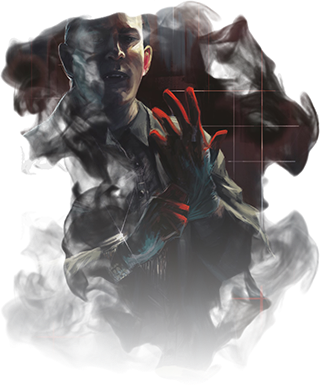
Nagaraja
In-clan disciplines
Description
Since their creation, the origins and existence of the Nagaraja have been obscured by lies, misunderstanding, and fear. Most vampires believe that the Nagaraja are a foul bloodline of flesh-eaters who practice primitive and abhorrent magics. The Nagaraja themselves have never had the numbers, ability, or the inclination to change the perceptions of their rumored origins and have remained mysterious and dangerous bogeymen for most of history.
Unknown to most modern vampires, the Nagaraja began as a Tradition of mages called the Chakravanti who studied death magics and embraced the Metaphysic Trinity: the concepts of dynamism, static, and entropy. They believed that these forces, when balanced, turn the Wheel of Fate and are governed by Brahma the Producer, Vishnu the Preserver, and Shiva the Purifier, traditional Hindu gods responsible for the creation, upkeep, and destruction of the world.
The origins of the Nagaraja can be traced back thousands of years to a centuries-long conflict between a group of ancient mages in the Himalayan region. Back then, a small band of Chakravanti mages experimented with vampire blood and the energies of the Underworld. These experiments infused them with the potent energy of death itself and led to their expulsion from the Chakravanti Tradition out of fear of where their studies would lead them. Embattled and at odds with their former brethren, the outcasts fled to Egypt. It was there that they discovered a mysterious creature who promised them the answers to death that they so desperately wanted. An ancient bargain was struck; the specifics of which are long forgotten.
Their benefactor provided them with a potent spell which promised everlasting power, but it was incomplete. To perfect the ritual, the mages sought vampire blood, hoping to amass enough power to enact the spell. They preyed upon their benefactor’s enemies, the Followers of Set, subduing them with their magics and collecting their vitae. The mages hoped that by utilizing vampire blood to complete the spell they could purify the embrace, but they were unable to avoid the karmic results of their actions. When the ritual was enacted the mages emerged as the vampiric Nagaraja, but it was to be a flawed and tortured existence, driven by an undying hunger for the flesh of the living and beset by enemies on all sides. They were horrified by their transformation.
Having learned of their transgressions, the Followers of Set were quick to decry the upstart bloodline of flesh-eaters with knife-like teeth, and the other clans of vampires remained their enemies. Though the embrace had heightened their necromantic powers, it was not enough to enable the Nagaraja to fight a war on all fronts. To ensure their survival, they scattered in all directions, avoiding the great vampire sects and operating in secrecy. Some sought refuge in the Shadowlands, seeking to create an enclave where their enemies could not follow; however, their efforts were fraught with peril as many of the eldest Nagaraja were destroyed in a great Maelstrom during the 15th century. Other complications followed, including conflict with the various empires of wraiths and the eventual destruction of their primary base of operations.
These nights the surviving Nagaraja are without allies. Burdened by the misinformation and narratives that condemn them as bogeyman and merciless cannibals, most Nagaraja have abandoned the Shadowlands and have begun to repopulate their numbers. These nights, rumors abound that the Nagaraja are working towards an alliance with the other necromantic clans.
Roleplaying Notes: The Nagaraja prefer candidates who have some relationship with death before the embrace. They are known to favor priests, spiritualists, morticians, exorcists, and even ghost hunters. They are also known to consider those who have had a brush with death, believing them to have caught a glimpse of the afterlife which may offer them a special insight. Very few embrace mortals who are violent criminals or murderers, as poorly chosen candidates sometimes fall victim to bad habits. The Nagaraja are very wary of their clan’s limitation and attempt to select candidates who can mitigate it accordingly.
All Nagaraja develop a metaphysical attachment to consuming flesh; however, the act itself is deeply ritualized and never a trivial undertaking. They believe that to consume a living person’s flesh is to take a portion of the being’s soul. A Nagaraja forced to consume dead or recently deceased flesh feels empty and unfulfilled, yet many embrace this way of feeding for moral or spiritual reasons.
As an independent bloodline without access to a parent clan’s merits, the Nagaraja are presented with a broader suite of merit options as well as their own unique flaws. As a reminder, you cannot purchase multiple Nagaraja specific merits of the same point cost unless otherwise stated. For example, you could purchase Lichborne and Necrosynthesis but you could not purchase both Necrosynthesis and To Catch a Killer.
Rarity: Uncommon Independent Bloodline with a cost of 2 merit points
Organization
The Nagaraja have suffered from both persecution and calamities that have left them scattered throughout the world. Many of them have spent time as refugees, living in back alleys, slums, and in some cases the Shadowlands. However, with the rise of the hunters occupying the attention of the major vampire sects, the bloodline has begun to repopulate itself, giving way to more structure. These nights, the newly embraced members of the bloodline often act as agents for older Nagaraja who in turn lead the bloodline to organize and strengthen its position. With few elders left in the clan, many Nagaraja are ignorant as to the truth of their bloodline’s beginnings. They are acutely aware that most, if not all, other vampires consider the Nagaraja a dangerous and vile bloodline of nefarious origin and are aware that their elders are seeking to change that narrative. The elders believe their best way to forge a path forward is to strike an accord with the other necromantic clans and bloodlines. However, they are adamant in their stance against the Followers of Set; a position which makes the Nagaraja a potentially polarizing ally.
Weakness
In addition to blood, the Nagaraja must consume raw living human flesh or the flesh of the very recently deceased. Whether a karmic punishment for the flawed ritual used to create themselves or as retribution from the Followers of Set, for every night a Nagaraja goes without consuming human flesh, she suffers a -1 penalty to all test pools. A Nagaraja may not benefit from the Herd background.
Quote
“The organ meats are full of nutrients, and are often pound-for-pound more sustaining than muscle meats. With the notable exceptions of tripe and brains, most organ meats are good sources of numerous vitamins and minerals. Now the liver is of especial interest, for it is a good source of vitamin D. Since you can no longer walk in the sun my childe, I recommend you start there.”
— Vysyn Hauq, Nagaraja
Clan merits
Clan flaws
- Ritually Inept1 pt
- Offal Appetite2 pt
- Snake Charmed3 pt